The sparrows carry George Stark away
The Dark HalfThe sparrows carry George Stark away in the novel’s climax, transforming the flock from an uncanny presence at the edge of human affairs into the force that ends Stark’s attack on the Beaumont family. As the birds enter the study and engulf him, the man who has treated violence as an instrument of control is borne out of the house and into the darkness. Their intervention is both a rescue and a death sentence: the sparrows act on their own terms, and no human character directs their final judgment.
The Flock Before the Study
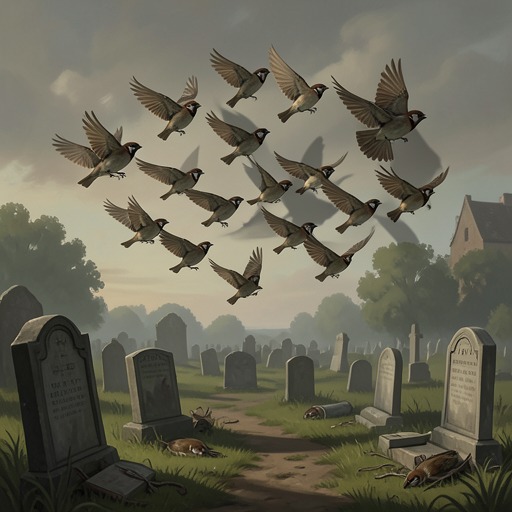
The removal of Stark follows a pattern of appearances that makes the final swarm feel less like a sudden arrival than the culmination of a long, unexplained approach. At Gold’s Junkyard and Auto Supply, Thad and Rawlie DeLesseps find the stacked vehicles on the back acreage carpeted with sparrows. The flock has gathered so silently that Thad has not heard it come, and Rawlie recognizes the birds as psychopomps while asking what their presence means. Their number and stillness turn a familiar place into a staging ground for an event neither man can interpret or command. The birds’ restraint around people is as striking as their numbers. When one lands on Alan Pangborn’s shoulder and hops onto his hand, he brushes at it; the sparrow does not attack, but pauses and later returns to the driveway flock. On Lake Lane, Alan finds the road behind him occupied by birds while the stretch ahead remains empty. He suspects that they do not yet want to approach more closely, as though the road and the slope by the Williamses’ A-frame were a staging area. The flock is therefore not simply a violent mass: it waits, occupies space selectively, and approaches the decisive scene in its own time. Thad encounters that boundary on his drive toward the house. A sparrow settles on the hood of his Volkswagen and peers in, while the birds ahead fill the road so completely that he understands he will have to drive over them if he is to reach the house. This encounter makes the flock’s presence a physical obstacle as well as an omen. By the time it enters the study, the birds have already shaped the route by which Thad approaches Stark and made plain that their movement cannot be treated as ordinary background.
The Attack in the Study
The decisive action begins with Stark advancing on Thad, a razor in his right hand. Thad retreats toward the study door and reaches for a pencil, but recognizes that it cannot match Stark’s weapon. The door opens wide enough for the sparrows to stream into the room. Stark’s expression changes from aggression to horror and recognition: he understands what the flock has come to do, refuses to go back, and tries to fend the birds off with the straight razor associated with Alexis Machine, the criminal protagonist of the Stark books. That familiar instrument proves useless against a force that does not answer to Stark’s rules. The birds cover his shoulders, arms, and head, and strike his chest in growing numbers. As they gather over the razor, its silver surface disappears beneath feathers. Stark fights back, but the attack continues; his attempt to use a weapon only marks the widening difference between his capacity for violence and the flock’s overwhelming collective action. The scene turns the blade from a sign of his mastery into an object the birds can bury and render ineffective. The flock also changes the immediate danger facing Thad and the twins. Thad retreats toward his children while sparrows settle on him and on the twins’ outstretched hands without pecking them. The children, who had been weeping, look up with wonder and delight. The birds’ violence is directed at Stark, while their contact with the family is calm. This contrast makes the event more than a simple attack by animals: the flock distinguishes between the man it has come to remove and the people gathered around him.
Escort to the Dead
The narration names the birds’ purpose directly: the psychopomps have come to serve as Stark’s escort back to Endsville, the land of the dead. That explanation gathers earlier sightings into a final function. The flock’s silent gathering at the junkyard, its occupation of the driveway and trees, and its advance into the study now form one continuous movement toward Stark’s departure. Yet the birds’ role does not make them human agents or instruments under anyone’s command; they arrive, act, and carry him away without being summoned by the people in the room. As the flock covers Stark, the struggle becomes an act of collective transport. The birds lift the increasingly diminished figure into the air, first inside the study and then toward the large, jagged opening in the east wall. Alan and Liz witness the movement from the guest room: what remains of Stark rises on a cushion of sparrows, falters, and ascends again toward the breach. More birds pour in through the opening, while the flock already inside moves into the study. The house’s damaged wall becomes the passage through which the birds take him. Outside, the mass carrying Stark rises above the trees. Alan sees the birds stream from the shattered windows, driveway, trees, and Rawlie’s Volkswagen toward a darkness shaped like a struggling man. The flock gathers around that central shape and moves it farther into the sky until it disappears from view. Thad joins Alan at the hole and says that Stark is gone. The statement marks the end of Stark’s physical presence in the house, while the birds’ ascent provides the scene’s visible confirmation of his removal.
Consequences and Significance
The family survives the immediate confrontation, but the scene does not frame the sparrows as a harmless or domesticated means of rescue. Their selective stillness around Alan, Thad, and the twins coexists with their relentless attack on Stark. The difference matters: the birds protect no human authority and obey no human plan. Their decision to carry Stark away resolves the danger at the house, but it also displays an independent power that the human characters can witness without mastering. The ending completes the flock’s shift from sign to actor. Earlier, the sparrows’ gathering raises questions for Thad and Rawlie, while their appearance on Alan and Thad’s routes alters what those characters can do. In the study, uncertainty becomes action: the birds enter, overcome Stark, and take him beyond the house. That progression gives their silence and patience narrative force. The climactic flight does not merely announce that Stark is defeated; it makes his departure a physical event, carried out by the same uncanny flock whose approach had been gathering across the story.